
India's economy grew 4.7 percent in 2013/14, marking a second straight year of sub-5 percent growth -- the worst slowdown in more than a quarter of a century.

Even if the Reserve Bank of India's Monetary Policy Committee decided to hold interest rates in the October meeting, it acknowledged the scope for further rate cuts while waiting for the impact of the past steps to play out.

India's net revenues from the Goods and Services Tax (GST) rose at a three-month high pace of 10.7 per cent in August even as growth in gross collections slowed to 6.5 per cent from 7.5 per cent in the previous month, thanks to a nearly 20 per cent decline in refunds to taxpayers during the month.

Foreign brokerages remain cautious on the road ahead for the Indian equity markets. Though analysts at Nomura have revised their March 2026 Nifty target to 26,140 levels from the earlier 24,970, but the upside from the current levels is a modest 6 per cent. BofA Securities, on the other hand, has not made any change to its year-end Nifty target.

India's economic growth will be above 6 per cent in the current fiscal as the country has managed to strengthen its macroeconomic stability and performance even in a period of large global shocks, RBI Monetary Policy Committee (MPC) Member Ashima Goyal said on Monday. Goyal further said that a global slowdown reducing India's export growth, geopolitics fueling oil and food prices, and erratic weather are some of the continuing risks that the country faces. "India has managed to strengthen its macroeconomic stability and performance even in a period of large global shocks.

For growth sustain at these levels, private services need to recover.
India's economic growth rate rose to an impressive 8.2 per cent during financial year 2003-04 as against 3.7 per cent GDP growth registered in the previous fiscal.

The power sector presents a puzzle. A fast-growing economy should be aligned to higher power demand but that hasn't been the case in the financial year 2026 till date (FY26TD).

The Indian services sector growth touched a ten-month high in June aided by robust expansion in international sales and job creation, amid positive demand trends and ongoing improvement in sales, a monthly survey said on Thursday. The seasonally adjusted HSBC India Services PMI Business Activity Index rose from 58.8 in May to 60.4 in June, driven by sharp upturn in new business orders.

Macroeconomic data, global geopolitical developments and rising concerns over AI-related disruptions are likely to dictate sentiment in the stock market next week, even as investors may remain cautious amid ongoing volatility, according to analysts.
India's GDP growth will slow down to 5.5 per cent in FY24 from the 6.9 per cent expected in the current fiscal 2022-23, a Swiss brokerage said on Wednesday. The slowdown was attributed to slowing global growth and tightening of monetary policies in the report by economists at UBS India. It said India will be among the "lesser affected economies" in the world, but made it clear that the world's fifth largest economy is not immune from global headwinds.
Weaker demand for Indian exports and higher financing costs will lead to a deceleration in India's gross domestic product (GDP) growth rate to 7.9 per cent in 2008, the International Monetary Fund has said.The IMF's growth projections for India are in line with other estimates, including that of the Asian Development Bank, which pegged the 2008-09 growth at 8 per cent.

Global rating agency Standard and Poor's (S&P) has said it expects India to grow by 6.5 per cent during 2013, amidst the possibility of global economic recovery continuing during the year.

The new IIP series based on the new base year, is expected to lead to better capturing of ground data
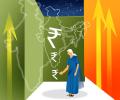
Citing various macroeconomic parameters that are doing pretty well, India's G20 Sherpa and former CEO of Niti Aayog Amitabh Kant projected that the country is all set to overtake Japan as 4th largest economy in the world by 2025. The size of India's GDP is currently ranked 5th, after the US, China, Germany, and Japan. It overtook the UK in 2022.

The Union Budget's focus on capital expenditure is expected to crowd-in private investment and push the GDP growth rate close to 7 per cent in the next financial year beginning April 1, said a Reserve Bank article on 'State of the Economy'. In 2023-24, capital expenditure is budgeted at Rs 10 lakh crore which will constitute 3.3 per cent of GDP. "We believe that India will decouple from macroeconomic projections of current vintage and also from the rest of the world.

Corporate India's net profit as a percentage of gross domestic product (GDP) dipped in the 2022-23 financial year (FY23) -- after rebounding sharply in FY22 -- amid a decline in global commodity prices. Top 500 companies' combined net profit stood at 4.1 per cent of the GDP for FY23, down from 4.3 per cent in the previous financial year when it had gone up from just 3.5 per cent in FY21. "The year-on-year (YoY) decline was led by global commodities, which contributed adversely to the ratio, while the financial sector contributed positively.

'We expect the Reserve Bank of India to deliver a 25 bps rate cut in April to support growth.'

Export-led Indian IT sector is not directly hit by Trump's tariff order on goods, but there could be worrisome indirect bearings on it arising out of possible slowdown in decision-making and GDP growth in America over higher tariffs, which may then cloud demand from specific verticals, according to some analysts.

Defence Minister Rajnath Singh lauds the armed forces' restrained response during Operation Sindoor after the Pahalgam terror attack, highlighting coordination and improved connectivity in border areas.

Whether nominal or real, India's investment rate needs to increase by 3 to 4 percentage points of GDP to support 8 per cent real growth, recommends Nikhil Gupta.

Sensex and Nifty post steepest weekly loss in over a year, falling nearly 3 per cent.

Investment proposals for around Rs 1.88 trillion through 35 major agreements, spread across deep tech, green energy, and aerospace, were the hallmark moment of the first day of the two-day "Telangana Rising Global Summit", which started on Monday.

Global financial services firm Nomura has sharply lowered India's growth forecast for this fiscal to 5.8 per cent, way below the government's projection, saying the country's monetary and fiscal policies are at loggerheads.

'Not paying workers enough will end up being self-destructive or harmful for the corporate sector itself.'

Moody's said the government will face challenges in achieving its deficit target for the fiscal year ending March 2021, amid persistent structural and cyclical headwinds to growth.
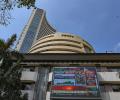
According to data from BSE, the 4,357 companies available for trade had a combined mcap of around Rs 416 trillion on Tuesday against India's GDP at current prices of Rs 296.6 trillion in FY24.

The Indian services sector growth touched an 11 month high in July, supported by a pickup in new exports orders and sharp rise in overall sales, a monthly survey said on Tuesday. The seasonally adjusted HSBC India Services PMI Business Activity Index was at 60.5 in July, little-changed from 60.4 in June, and the rate of expansion was the best seen since August 2024.

'The US reciprocal tariff has added another element of uncertainty and the central bank may prefer to wait and get further clarity.'

India's first $1 trillion company by market capitalisation (mcap) is achievable by 2032 and HDFC Bank and Reliance Industries (RIL) are seen as lead contenders, ICICI Securities said in a note on Monday. To achieve this, the shares of both the firms will have to appreciate at least 20 per cent annually for the next decade. ICICI Securities believes this is possible if India's gross domestic product (GDP) growth accelerates to 9 per cent per annum and corporate profitability cycle peaks. "Our calculations suggest that India's first $1 trillion mcap stock could emerge by 2032.

The weakening of inflation, prospects of economic growth, geopolitical uncertainty and comfortable system liquidity may result in the Reserve Bank of India's (RBI) Monetary Policy Committee (MPC) to cut the repo rate by another 25 basis points, opine top economists. They also said the external economic pressures like trade policies and others would require continued RBI's accommodative stance and policy support for the Indian industry to sustain the growth.

The gig economy market is expected to grow at a compound annual growth rate (CAGR) of 17 per cent to reach a gross volume of $455 billion by the end of 2024, according to a white paper by The Forum for Progressive Gig Workers. Estimates suggest the gig economy has the potential to create 90 million jobs and add 1.25 per cent to India's GDP (gross domestic product) over time.

The World Bank on Tuesday raised the growth forecast for the Indian economy to 7 per cent for the current fiscal year on the back of recovery in agri sector and rural demand. World Bank had in June projected India to grow at 6.6 per cent for FY24. According to the World Bank Report released on Tuesday, India's growth continues to be strong despite a challenging global environment.

The crisis may not be as visible this time, but the stakes are just as high, points out Rajeswari Sengupta.

The shares of Titan Company hit its all-time high on the BSE and was the top gainer in the Sensex on Wednesday after the company released its business update for the third quarter of 2025-26 (Q3FY26). The stock closed at 4,272, up 3.94 per cent as compared to the Sensex, which was a tad down.

'Instead of one or two families controlling 10% to 15% of GDP, it has to be broad based. Then, the resilience of the economy also will be higher.' 'Then, if something happens to one business, it will not hurt the economy badly.'

Stock markets are likely to trade in a range-bound manner in a holiday-shortened week where trading activity of foreign investors, currency movement and global macroeconomic data announcements are expected to drive sentiments, analysts said. Several global markets may see subdued activity on account of Christmas and New Year holidays, an expert said.

India's services sector growth touched a four-month high in December, supported by new business inflows on strong demand conditions and easing inflationary pressures, a monthly survey said on Monday. The seasonally adjusted HSBC India Services Business Activity Index, rose from 58.4 in November to 59.3 in December, highlighting the strongest rate of expansion in four months.

The Reserve Bank of India (RBI) on Friday said it expects the economy to record positive growth in the second half of the current financial year.

The Asian Development Bank (ADB) on Wednesday slashed India's GDP growth forecast for FY23 to 7 per cent from the earlier estimate of 7.2 per cent mainly on account of higher inflation and a tight monetary policy. India's economy grew 13.5 per cent year-on-year in the first quarter of 2022-23, reflecting strong growth in services, ADB said in its second supplement to Asian Development Outlook Report 2022 (ADO 2022). "However, GDP growth is revised down from ADO 2022's forecasts to 7 per cent for FY2022 (ending March 2023) and 7.2 per cent for FY2023 (ending March 2024) as price pressures are expected to adversely impact domestic consumption, and sluggish global demand and elevated oil prices will likely be a drag on net exports," ADB said.
